The digital twin has stopped being a technology and is now becoming an enabler for new service-based value propositions, allowing us to understand the different options that exist and the consequences of them.
The twin does this by helping us to make sense of what is going on in a system, and supporting our decision making by translating the data into actionable information. Figure 1 shows a complex system based around mobility where we have many people active in the system, along with many machines and almost everyone wanting answers to different questions.
The digital twin allows us to combine data with both tacit and explicit knowledge to create new understandings from which new value propositions could be derived.
As part of an ongoing development project, we have been developing digital twins to support new solutions or value propositions that were not previously achievable. The cases were all complex and involved a combination of people and machines, also they were based on real-world cases rather than assuming new ‘ideal’ installations. This was challenging as it meant that the data quality was ‘messy’ and in some cases there was no live data – this is in-fact reality!
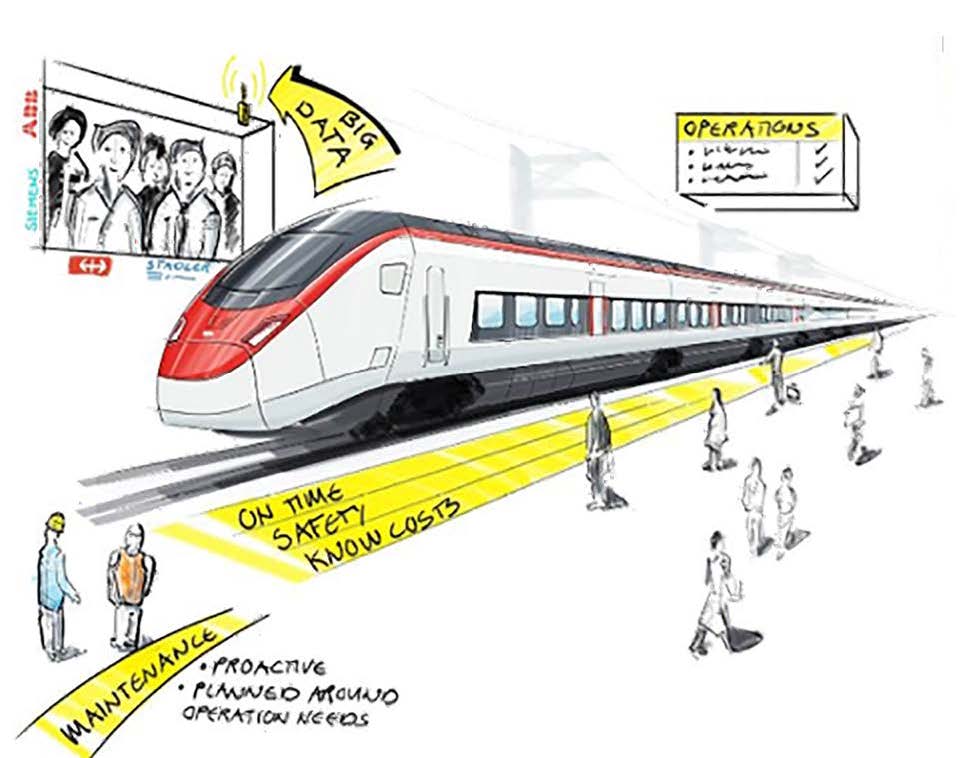
Figure 1 The digital twin can help many people with many different points of view
We first mapped out the problem space for each of the cases so that we understood the different people, the different situations that could exist, and the machines and possible data streams.
Do so, and you start to realize how little you actually know about people and their problems. One of the most powerful approaches we found, was to create a list of questions that people might need to address for different situations.
This helped greatly to describe the cases in detail before coding and supported the matrix describing different situations to be completed, typical questions we found were:
- “How do I effectively match demand with capacity?”
- “Why do we lose production – we follow the OEM recommendations?”
- “What are the “real” costs of production?”
- “How long will this job take?”.
The Ten Use Cases in Detail
Based on the problem space descriptions, we then started to code the digital twins (mostly based on agent-based modelling) and at the same time detailed out the value proposition.
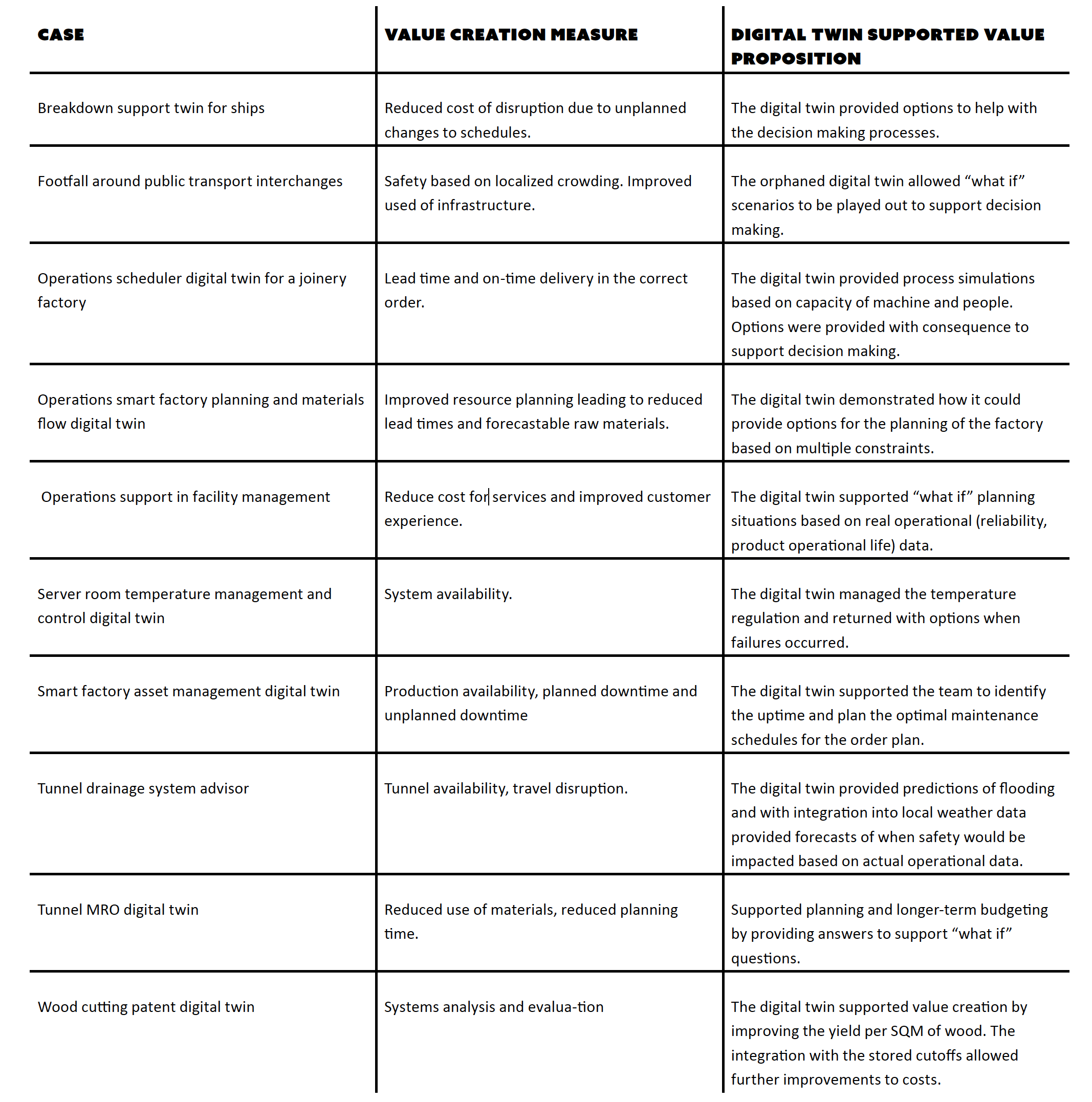
For each case the purpose and the value propositions provided will be described, along with the main source of customer value. Interestingly, all of the twins developed contained aspects of value co-creation. All were developed off-line using real or manufactured data to support the simulations – even with just the simulation data the digital twins provided additional insights that support decision making.
- Breakdown support twin for ships – the twin mimics the current status, allowing drill-down to individual ships and the subsystems within each ship. The twin then supports decision making for planning and scheduling routes based on actual status and unplanned corrections. The value is derived from the reduction in disruption when changes occur and understanding the loss of operational availability associated with unplanned events.
- Footfall around public transport interchanges – the purpose is to better manage the flows of individuals around a station based on the current and future station layout and train schedules. The value comes from improved traveler safety through the re-platforming of trains and/or investments in new walkways or simply better placed signage to improve flows.
- Operations scheduler digital twin for a joinery factory – the purpose was planning optimization around a production process with bottlenecks in individual competences and machine capabilities. The main source of value is efficient production planning, with known delivery dates and costs.
- Operations smart factory planning and materials flow digital twin – a system capability twin matched demand to support the development of a dynamic operations planning twin. The main value is from the provision of planning support for the ‘optimal’ production schedule, and for creating an agile planning tool presenting the cost of changes along with a different planning solution.
- Operations support in facility management – the digital twin provides operations support for Facility Management (including routine maintenance, planned maintenance and unplanned maintenance). Value would be created from reduced spares holding and faster task scheduling and cost estimation.
- Server room temperature management and control digital twin – the purpose of this twin is to improve overall equipment up-time and provide further business stability through equipment risk mitigation. Value accrues from operational support, temperature stability, and routine reporting.
- Smart factory asset management digital twin – the purpose was planning, to support the different models of maintenance and operation to find the required compromises between different demands. It also allows new equipment to be integrated into the system to simulate outcomes based on different configurations. The value is created from an agile O&M schedule, allowing run-ons to be examined for additional maintenance costs. Additional value comes from improvement plans for modifications to improve factory performance.
- Tunnel drainage system advisor – the purpose of the digital twin is to monitor the water levels and give predictions based on the weather conditions and other factors that influence the water level in the tunnel. The value comes from keeping the tunnel safe and operational, measured by performance.
- Tunnel maintenance, repair and overhaul digital twin – the twin supported maintenance service delivery by improving planning of maintenance and increasing the efficiency of field service engineers.
The main source of value from the digital twin was identified as keeping the tunnel operational, with an availability metric to measure performance of the MRO team.
Two of the value propositions built are now in the process of being sold to customers. The detailed understanding of the problem and the value creation (and destruction) has helped establish the sales process and the pricing structures. The input from the launch customers has been useful in helping to validate the value proposition, and in some cases resulting in an improved value proposition based upon their real-world feedback.
The value propositions would not have been possible without the underlying digital twins, the simulations and the detailed problem space descriptions.
What should you do if you want to create new value propositions enabled by digital twins?
To help you, we recommend three things that you could do to help your organisation, based on our insights from the study:
- Spend time to describe the problem space from many different points of view and in different situations.
- Use real questions driven by customer issues to help you clearly define the situation and the outcome that the people are expecting.
- Develop the value proposition together with a launch customer.
What are we doing to help with the design of digitally enabled value propositions? We are collating the lessons from the project and creating a playbook to help organisations understand the problem space in depth. This will help guide them how they could model the system and then provide hints and tips on possible value propositions.
Acknowledgments
I would like to thank Oliver Stoll ([email protected]) and Petra Müller-Csernetzky ([email protected]) and for providing valuable input into the study. The study was co-financed by Innosuisse (Project 35258.1 IP-SBM) and delivered in partnership with ten partners and led by Jürg Meierhofer ([email protected]).